What's New

Japan-USA NPO Communication Project Jan 2005 : The Ikimachi hosted Deborah
and Ted from the Main Street Program, USA

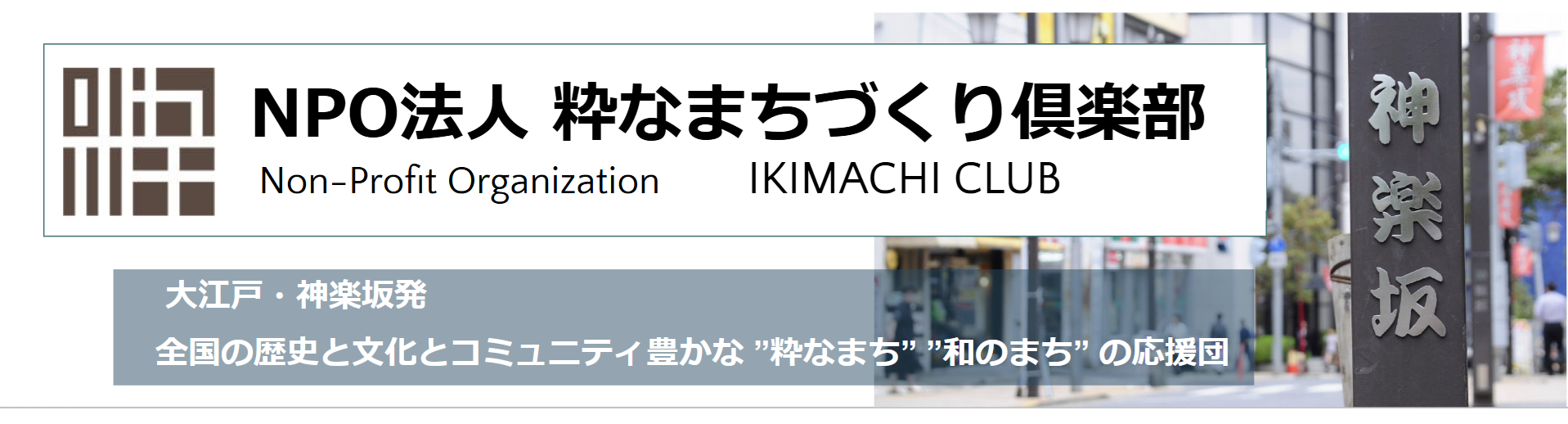
Kagurazaka District is located at almost the center of Tokyo, in the middle of JR Yamanote Line which runs through major downtowns of Tokyo as a circle.  It is at the eastern-north edge of Shinjuku Ward. Kagurazaka is relatively compact area and the night time population is about 3,000.
In order to access Kagurazaka by public transit, three train/subway stations are conveniently usable; Iidabashi Station (JR Chuo Line Local Service, Subways Tozai Line, Yurakucho Line and Namboku Line), Kagurazaka Station (Subway Tozai Line) and Ushigome Kagurazaka Station (Subway Oedo Line).
Today, Kagurazaka is famous for its lively main street, called Kagurazaka-Dori (Dori or Tori means “street.”). There spread both commercial and residential areas on both sides of the street. There are several educational institutions such as Tokyo University of Science, Hosei University and France-Japan Institute. There are also many small printing and book-binding companies. In this way, Kagurazaka is also known as a highly cultural downtown
Among anything else, Kagurazaka is known as one of a few downtowns in Tokyo where traditional Geisha Girl culture and their guest houses called “Ryotei*1” still exist lively. The Ryoteis form their own special social/cultural rules and manners, called “Karyukai *2,” which influences soundly upon Kagurazaka’s local characters.
Also the narrow and stone-paved alleys called “Roji,” that run through wooden structured and one or two -storied Japanese style housing, form the maze-like street patters and the special townscape of Kagurazaka. “Zaka” of Kagurazaka means slope, and as the name shows, there are quite a few slopes and steps in the town.

Note *1 Ryotei) In Ryotei, Geisha’s performance, such as dance, Japanese musical instruments and song are shown along with traditional Japanese dinner. Many Ryoteis keep traditional Japanese style architecture and located along Roji, which contribute to preserve the special atmosphere of the district.
Note *2 Karyukai) Karyukai is a certain district where Ryoteis exist and Geishas walk around. It also has the implication of social, economic and cultural society of the Ryoteis and Geishas in the district.  Karyukai keeps Japanese traditional and cultural world of Geisha’s dancing, singing, playing of musical instruments, manner of guest treatment, Kimono (Japanese traditional clothes) dressing and make-up etc. Geisha Girls do their performance in Ryotei over Japanese traditional dinner. Karyukai  contributes to preserve the special sense of place and atmosphere of the district.
The administrative center of Karyukai is a union called Kenban, where Ryoteis and Geishas belong to. Kenban manages administrative issues for Geishas, and also functions as the total life-support and training center for Geisha, including singing, dancing, musical instrument, Kimono dressing and make-up, and financial issues etc. Today 6 districts in Tokyo hold Karyukai.

【MAP】

History of Kagurazaka goes back to the early 15th century when Ushigome castle was built. Basic structure of the town was built in the first half of the 17th century and Kagurazaka-dori (street) was shaped in mostly like what it is today. In the Edo period from early 17th century through the end of the 19th century, Kagurazaka was flourishing with shops, festivals, red-lights, surrounded by many Samurai (Japanese soldier) houses, temples and shrines. Festivals of the Bishamonten was most popular.
In accordance with the change of government system in 1867, from Edo feudalism to Meiji central government, Samurai houses were removed and Kagurazaka   started to become a downtown for merchants and residents. The opening of the Chuo Line in 1894 gave Kagurazaka the big opportunity to step up to be a commercial center in Tokyo. “Karyukai” was born in the district and started to become prosperous. In addition, cultural entertainments have developed in Kagurazaka. “Yose”(popular entertainment such as telling funny stories, trick & magic, playing musical instruments etc.), movie theaters, “Enbujo” theater (traditional dancing theater), and other cultural places emerged.
Many cultural figures loved Kagurazaka. Famous authors who represented the Japanese literature of the days, such as Soseki Natsume, Kafu Nagai, and Kyoka Izumi, lived in this area.
In Taisho Era (1911-1925), Kagurazaka kept growing, and because Kagurazaka had very few damages by the Great Kanto Earthquake in 1923, Kagurazaka became one of the most flourishing downtowns in Tokyo after the earthquake.
The prosperity continued till early Showa Era (till mid 1910’s) and Karyukai held more than 600 Geishas. However, as the country went into the war, people’s lives had become very severe, and commercial and cultural activities were forced to cease down. In 1920 most part of Kagurazaka was burned down by the air raid on Tokyo and people suffered from serious damages.
It was not easy to recover from the damages of the war, but Karyukai took the leading role for reviving Kagurazaka and got back to its peak flourishing in 1960’s. On the other hand, revival of the shopping street was delayed. The economic bubble started in 1980’s, and while the bubble brought Karyukai another economic boom, land assembling that aimed for large-scale development broke out and steadily giving damages and changes to the district, such as the construction of high-rise condominiums (residential towers) that do not match the historic landscape of the area.
In the last 10 years, many shop owners never bowed to the pressure of such land assembling and kept their businesses, but at the same time there are more and more chain stores lining up along Kagurazaka. Also Karyukai is decreasing its activity mainly because of the difficulty of finding successors and economic recession.
And TODAY, Kagurazaka is facing a major turning point under the circumstances of the trend of migrating back to urban centers and revaluation of Japanese traditional intimate townscape, local community and matured culture. Since the impact by the land assembling was not strong enough to destroy the district, its traditional character as “harmonized and stylish town” still remains today. Now Kagurazaka often receives a high degree of media coverage and is increasing its visibility. However, because of its high level of livability, Kagurazaka is getting new pressure of development which threatens not only the historic townscape but also its community tie and succeeded local spirits.

Under such circumstances, The Ikimachi-club was organized in 2003 and started a lot of activities for preserving and revitalizing the indigenous, original and tasteful culture and space. The people, who live, work or love Kagurazaka, are getting together and supporting its regeneration in many different ways. We planned and carried out many events such as town walking tour, billboard workshop and “Rakugo” show (traditional Japanese comic storytelling) at the Bishamonten-Temple, which is located in the center of the main street. We believe that these projects are telling profound characteristics of the area.
At the same time, we are building networks with other groups, who share the same spirit, through quarterly symposium with the experts in city planning,   historic preservation and other activities. One of them is the “Main Street Program”of the United States, from which we invited two experts and have started to discuss the way to apply the program to our situation. The club has also started to create special and comprehensive local schemes for district planning, architecture, funding etc., as all these elements are related together and must be solved comprehensively to strengthen and preserve the local assets. It is a challenging task but we are all ready to go for it.